"Notes are something you make, not something you take." -Craig Buzska
Mark showed us his circular motion practicum: He has a flying cow toy, which he suspends from the ceiling. After he gets it moving, he measures the radius of its motion using a pair of meter sticks (one along the ceiling, the other held vertically above the cow to mark the radius on the ceiling ruler). Then he times a few revolutions, counting aloud. Finally, he turns the cow off and measures the length of the string holding it up. The question for the students is: given the radius and the length of the string, what is the time on the stopwatch?
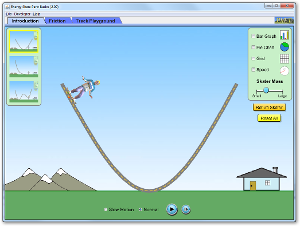
After a short break, we charged on into Energy. No one has any idea what energy is, but it's an enormously useful concept. We had read Feynman's Dennis the Menace analogy for homework (which Craig gives his students on the first day of classes) and then played with the Energy Skate Park simulation:
Then, we did two worksheets and whiteboarded them, coming up with some great questions to ask students and ways to link back to previously discussed concepts. Shirley talked about her school's Grand Prix rubber-band car race and some ideas for using rubrics to convey the different levels of mastery. Mark shared an awesome analogy for dissipated energy involving tripping and spilling a huge sack of quarters into the Hudson River: you could send divers after the quarters, but that would cost more than the value of the quarters themselves.
After our qualitative discussion, we talked about developing a common terminology and notation. For the workshop, we're using Emode for all energy, to emphasize that "energy is energy is energy". Last year, several students had trouble distinguishing between an 'E' and a 'Σ', so I was happy to use Kelly O'Shea's notation instead. This year, I'll see what the text uses and hope I can get my students to draw a proper Σ...
After that, we started the suite of labs that will (so Mark and Craig tell us) show us how to count our energy blocks. Tomorrow we'll finish the labs and discuss Swackhamer's Making Work Work. I'm looking forward to talking about how to fit energy flow diagrams into LOL diagrams and relating those to interaction diagrams/system schema and the system designations we did for the qualitative worksheets.
(In case anyone's curious, I made four pages of notes today, plus writing notes on four worksheet pages.)
Showing posts with label daily updates. Show all posts
Showing posts with label daily updates. Show all posts
Tuesday, July 24, 2012

Monday, July 23, 2012
NYC Modeling Workshop: Day 11
Today was a bit of a blur: We zoomed through both projectile motion and circular motion. I'm working up my store of questions to ask students when they present whiteboards, along with potential modifications to the standard problems and labs. Watching Mark's patter as he leads us through the labs is really fun. I hope to be half as good as he is within the next five years.
Some standout (but not necessarily new) ideas:
Some standout (but not necessarily new) ideas:
- Explicitly relate the x-t graph to the motion of the projectile's shadow on the floor (when illuminated from directly overhead) and the y-t graph to the projectile's shadow on the wall (when illuminated directly from the positive/negative x-direction).
- As an extension, have advanced students make a video of something with significant air resistance being tossed instead of a nice, aerodynamic ball.
- Tie all 'errors'/'limits to precision' back to 'tools, techniques, and environment'.
- The spinning-track CFPM demo apparatus is awesome.
- Use a video of the whirling stoppers lab done badly to discuss safety and reliability issues with students.
- To help students visualize force diagrams, build 3D versions out of straws and putty.
There was some debate about whether tangential velocity increases when you increase the centripetal force and radius is free to change, or if it just looks faster because the angular velocity increases. Anyone know?
Thursday, July 19, 2012
NYC Modeling Workshop: Day 9
Side note: Making notes with an eye towards blogging about the day's discussions has helped me reflect even when I don't get around to writing the blog posts. I highly recommend it.
Tuesday, July 17, 2012
NYC Modeling Workshop: Day 7
"Imagine you couldn't give the test at the end of the unit, but had to wait until a year later. What would you teach, and how would you teach it?" Mark Schober started us out today with that quote from a sponsoring professor from another workshop. I don't know about you, but I don't think I'd teach the way I was taught. Sure, I remember some ideas from my high school physics class, but a) I was really interested and b) I've used those ideas quite a number of times in the decades since.
Monday, July 16, 2012
NYC Modeling Workshop: Day 6
Commuting rather wrecked my brain last week. I don't know how people who commute over an hour every day stand it: there's no time left for anything else, and attempting to shoe-horn in homework after hanging out with my daughters left me severely sleep-deprived. I'm going to try to do homework on the train this week, which might work better than doing homework on the bus last week. (Not that that's difficult, mind you, since drawing graphs on a bus is practically impossible.)
Tuesday, July 10, 2012
NYC Modeling Workshop: Day 2
I confess I was late to class today. In my defense, I'm not in charge of NYC buses or traffic on the George Washington Bridge (just in case there was any confusion on that point). So I missed the lead in to the whiteboard meeting discussing the Measurement & Graphing station lab. Fortunately, I didn't miss the discussion itself.
Monday, July 9, 2012
NYC Modeling Workshop: Day 1
Today was the first day of the Modeling Workshop graciously organized by Fernand Brunschwig and PhysicsTeachersNYC. After getting up way too early and catching two buses, I found my way to the site. (It's a little odd to be walking into the buildings on the north side of 120th instead of the ones on the south side of 120th. I will have to squeeze in some time to visit some of my college haunts.)
Thursday, May 31, 2012
Wednesday, January 25, 2012
Resolutions for the new quarter
I'm going to stop making resolutions about blogging, because I'm just not keeping them.
I am going to make a resolution about my teaching, though: I'm going to make a clearer distinction between learning, practice, and assessment activities. I'm going to use some ideas from mastery teaching, and focus my students on my core standards before they can move on to the advanced standards. I'm going to give up on trying to keep everyone on the same page when the range in ability, motivation, work habits, home environment, and just about everything else is huge. I want everyone to reach the core standards, but that doesn't mean everyone has to do the same thing at the same time.
I am going to make a resolution about my teaching, though: I'm going to make a clearer distinction between learning, practice, and assessment activities. I'm going to use some ideas from mastery teaching, and focus my students on my core standards before they can move on to the advanced standards. I'm going to give up on trying to keep everyone on the same page when the range in ability, motivation, work habits, home environment, and just about everything else is huge. I want everyone to reach the core standards, but that doesn't mean everyone has to do the same thing at the same time.
Thursday, January 19, 2012
Student Prejudice
There's something nauseating about virulent prejudice from a teenager. I'm not talking about the casual use of ethnic, racial, and gender-based slurs that seems to permeate the culture. I'm talking about saying "some [of this group] just need to be beaten," talking about torture, and insisting that this is just the way the world is. During class. With members of the target group listening. To the teacher, who is a member of the target group...
Tuesday, January 17, 2012
Efficiency
After my last class of the day today, two students stayed behind to discuss their progress. I took out their latest tests and we went over the tests together. I pointed out where they met the standards and where they were close, as well as where they fell short. We clarified some ideas, I gave out some (additional) practice work, and we arranged reassessments.
Then I went to my PLC meeting, which is focused on improving the workflow so that teachers have more time for teaching. (One of the things we've been working on is reducing the amount of time we spend at the copy machine.) We're trying to find out what our colleagues would find most useful, and one (among many) of our ideas was streamlining grading somehow. At the time, I thought that would be great. Who wouldn't want to spend less time at home, writing comments on papers that will get stuffed into backpacks and ignored? But as I was thinking about it tonight, I decided that I don't need to streamline grading at all. I need to slow it down. I need to spend more time grading with my students next to me. I need to talk to them as I'm grading their work, so that the feedback cycle is timely and my comments (and their responses) have a better chance of being listened to, as well as heard...
Then I went to my PLC meeting, which is focused on improving the workflow so that teachers have more time for teaching. (One of the things we've been working on is reducing the amount of time we spend at the copy machine.) We're trying to find out what our colleagues would find most useful, and one (among many) of our ideas was streamlining grading somehow. At the time, I thought that would be great. Who wouldn't want to spend less time at home, writing comments on papers that will get stuffed into backpacks and ignored? But as I was thinking about it tonight, I decided that I don't need to streamline grading at all. I need to slow it down. I need to spend more time grading with my students next to me. I need to talk to them as I'm grading their work, so that the feedback cycle is timely and my comments (and their responses) have a better chance of being listened to, as well as heard...
Tuesday, January 10, 2012
Fell off the wagon
After complimenting myself on making a 6-day posting streak, I promptly fell off the bandwagon and didn't post for 3 days. I'm going to claim a birthday vacation and start over...
One of my classes, the smallest, includes a group of students who are obsessed with gossip (celebrities, tv characters, and fellow students alike, everyone is fair game). Today's rendition included full-voiced insistence that several musicians are members of the Illuminati. When I tried to stop the conversation, I was accused of being mean, picking on the students who were talking, and consequently being racist. If I called home every time this sort of behavior occurs, I'd be on the phone with the parents of these students every day. Maybe that's what it will take...
One of my classes, the smallest, includes a group of students who are obsessed with gossip (celebrities, tv characters, and fellow students alike, everyone is fair game). Today's rendition included full-voiced insistence that several musicians are members of the Illuminati. When I tried to stop the conversation, I was accused of being mean, picking on the students who were talking, and consequently being racist. If I called home every time this sort of behavior occurs, I'd be on the phone with the parents of these students every day. Maybe that's what it will take...
Saturday, January 7, 2012
I'm late, but...
Still awake, mostly, at least.
The thought that sticks with me from today is that it's a complete and total waste of human potential to have a bright student stuck in the slowest regular ed track simply because this student can't see the chalkboard clearly. How can we justify (we, the school system that has no quick way to identify such students, the corporations that refuse to cover the costs, the politicians who see every effort to help people as a horror leading directly to Stalinism, and the voters who allow/encourage scare tactics masquerading as political campaigns) letting a student sink into bitterness because we don't provide a remedy that's been around for centuries? We're still one of the richest countries in the world, even if our child poverty rate is ridiculously high compared to other rich countries. How can we bear to waste a child's potential to preserve the profit in a pair of eyeglasses?!?
The thought that sticks with me from today is that it's a complete and total waste of human potential to have a bright student stuck in the slowest regular ed track simply because this student can't see the chalkboard clearly. How can we justify (we, the school system that has no quick way to identify such students, the corporations that refuse to cover the costs, the politicians who see every effort to help people as a horror leading directly to Stalinism, and the voters who allow/encourage scare tactics masquerading as political campaigns) letting a student sink into bitterness because we don't provide a remedy that's been around for centuries? We're still one of the richest countries in the world, even if our child poverty rate is ridiculously high compared to other rich countries. How can we bear to waste a child's potential to preserve the profit in a pair of eyeglasses?!?
Thursday, January 5, 2012
Different Expectations
A colleague told me of a student who wants to transfer to a different class because my colleague assigns too much homework. Despite being in an honors physics class, the student has weak algebra skills, so the assigned homework takes this student longer than it ideally should, but the real reason the student wants less homework is because the student really wants to be a concert pianist, and physics homework is cutting into precious piano practicing time... Unfortunately, "I don't like the teacher" or "the teacher assigns too much homework" isn't considered an acceptable reason for a schedule change in our school, in the name of fairness (not giving some teachers a greater workload, giving all students an 'equal chance' at particular teachers) and rigor (chiefly not allowing students to play teacher lottery by changing classes until they find a teacher who doesn't ask them to do anything challenging)...
Frankly, I find it depressing that this budding pianist apparently is being forced to spend her deliberate practice time in ways she'd rather not, no matter who is pressuring her to choose physics homework over piano practice.
Frankly, I find it depressing that this budding pianist apparently is being forced to spend her deliberate practice time in ways she'd rather not, no matter who is pressuring her to choose physics homework over piano practice.
Wednesday, January 4, 2012
Tutoring
Sometimes I think tutoring is all of the most enjoyable parts of teaching without any of the annoying bits (but that's probably because I'm not trying to make a living tutoring). When I tutor, whether it's my school students or private students, I get to focus on an individual's understanding. I can tailor my explanations and analogies to a single student's interests. One student finds math easy and responds to algebraic explanations, while another finds math difficult and responds best when my explanations revolve around the physical sensations of movement: when I'm tutoring, I can lead the first student to an understanding of the movement through algebra and the second to an understanding of the algebra through movement. When I'm teaching, I have to try to go both ways down that road at once, which can work, but isn't nearly as enjoyable.
For Mr. Burk: the app is Teacher Assistant Lite. The trial version is too limited (max 5 students and 3 actions/student) for me to get a good sense of how I'd use the full version.
For Mr. Burk: the app is Teacher Assistant Lite. The trial version is too limited (max 5 students and 3 actions/student) for me to get a good sense of how I'd use the full version.
Tuesday, January 3, 2012
A Good Day
Some days are better than others. Today was a reasonably good day (although, of course, not perfect). The workday ended with a conversation with my principal that settled a bit of my own foot-in-mouth disease, after a faculty meeting that actually involved conversation rather than lecture, which came after a day in which most of my students, while reluctant to resume the hard work of learning when it involved dragging themselves out of bed on a frigid morning, were largely polite to those around them. And I found an app that might help me track anti-social behavior and thereby give better feedback on it.
And I'm heading for bed before midnight. What could be bad?
And I'm heading for bed before midnight. What could be bad?
Monday, January 2, 2012
Compression Algorithms
Because I'm implementing both modeling and SBG, I'm well behind where I wanted to be, curriculum-wise. That means compressing the remaining first semester material into the month of January, which means combining projectile motion and uniform circular motion into the tail end of unbalanced forces as "non-linear motion". Fortunately, I have just the video to introduce it: Jerome Simpson flipping into the endzone
Thursday, November 17, 2011
Long Time No Blog
I've been neglecting my blogging. Not because I haven't been reflecting. Not because I don't remember how good blogging is for processing and reflection, but just, well, Ashleigh Brilliant's quote about days ganging up on me feels about right.
We've just started Constant Acceleration, and I'm wrestling with trying to separate the standards far enough to write quiz questions that test the understanding associated with only one standard. To make matters more complicated, all three tracks use the same curriculum and standards but need different levels of question and I am expected to adjust the definition of "mastery" so that students in all levels are challenged but not overwhelmed. Here's what I have so far for CAPM: CAPM Standards Rubric
Quote: "I try to take one day at a time, but sometimes several days sneak up on me at once." (Or something to that effect.)
We've just started Constant Acceleration, and I'm wrestling with trying to separate the standards far enough to write quiz questions that test the understanding associated with only one standard. To make matters more complicated, all three tracks use the same curriculum and standards but need different levels of question and I am expected to adjust the definition of "mastery" so that students in all levels are challenged but not overwhelmed. Here's what I have so far for CAPM: CAPM Standards Rubric
Quote: "I try to take one day at a time, but sometimes several days sneak up on me at once." (Or something to that effect.)
Friday, October 21, 2011
Grades, Failure, and Success
Yesterday was an interesting day. I'm behind in my feedback. (I'm always behind in my grading. I'm hoping that figuring out how to do voice feedback will speed up my process, if only to reduce the temptation to go back to multiple choice and other easily graded assessments.) And progress reports went out in the middle of the week, so several students asked me "What's my grade in this class?" I repeated my explanation that their grade doesn't exist until the end of the quarter. (Blame Kelly O'Shea.) "But I want to know if I'm failing." "You're not failing, unless you decide to stop learning." "So am I failing?" "You haven't met all the basic standards yet, but you have time." "So I'm failing."
The temptation to bang my head against a wall was fortunately fleeting. The depressing part is that I have the feeling from some of my students that they want me to tell them that they're failing, so that they have an excuse to stop struggling with difficult concepts. (And let's face it, Newtonian thinking is difficult: otherwise Aristotle and the other Greeks might have figured it out.)
Fortunately, several of these conversations were interrupted by other students saying "She doesn't give grades yet. Just chill." and words to that effect.
And, after my honors class took a quiz and gave themselves feedback a la Frank Noschese, one student asked, "What happens if we got it wrong?" "What happens when you get stuff wrong in this class?" "You try again?" "Exactly." Made my afternoon.
The temptation to bang my head against a wall was fortunately fleeting. The depressing part is that I have the feeling from some of my students that they want me to tell them that they're failing, so that they have an excuse to stop struggling with difficult concepts. (And let's face it, Newtonian thinking is difficult: otherwise Aristotle and the other Greeks might have figured it out.)
Fortunately, several of these conversations were interrupted by other students saying "She doesn't give grades yet. Just chill." and words to that effect.
And, after my honors class took a quiz and gave themselves feedback a la Frank Noschese, one student asked, "What happens if we got it wrong?" "What happens when you get stuff wrong in this class?" "You try again?" "Exactly." Made my afternoon.
Saturday, October 15, 2011
Deliberate Practice
I've been thinking about deliberate practice: how do I encourage my students to practice physics, rather than staring at notes (or complaining that I don't give them enough notes to stare at)? Part of it has to be the sort of in-depth conversation I had with several students this week, as we discussed the parts of the CVPM standards they met and the parts they haven't yet met. (Even if it boggles my mind that sophomores can be uncertain about their answer to the question: if Carla drives 120 miles at 60mph, how much time did she spend on the road?)
What's working:
What's working:
- Standards-Based Assessment: I'm not balancing points, and my students don't have an excuse to give up yet, because they're not failing.
- Mistake Game: my Honors kids (who hate making mistakes in public) are still eager to get up and present their solutions.
- Feedback mechanisms aren't fast enough. I'm thinking about Frank Noschese's orange pens for quizzes, and screencasting my comments on other assessments.
Subscribe to:
Posts (Atom)